What is added to swimming pool water?
 By the Find My Swimming Pool team·
Updated ·
6 min read
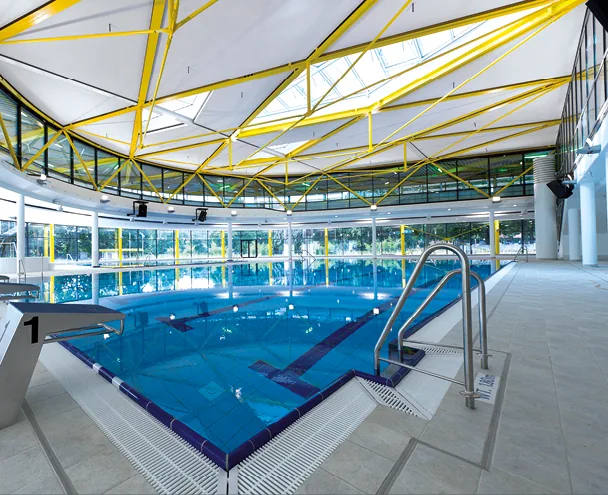
Pool water looks simple, but a public pool is a small water treatment plant. A handful of chemicals keep it free of germs, gentle on your eyes and clear enough to see the bottom of the deep end.
The short answer
Most pool water contains a disinfectant, almost always chlorine, plus chemicals to keep the pH in the right range. Many public pools also add a coagulant (often called a flocculant) to help the filters catch tiny particles. Some add a buffer such as sodium bicarbonate, calcium to protect the tiles, or cyanuric acid in outdoor pools to stop sunlight burning off the chlorine. The amounts are small and tested several times a day.
The disinfectant: chlorine
The main job of pool chemicals is to kill germs that swimmers bring in. Nearly every public pool in the UK, Ireland, Australia, Canada and Europe uses chlorine for this. It comes in a few forms:
- Sodium hypochlorite. A liquid, close to strong household bleach. Common in large public pools, dosed automatically by pumps.
- Calcium hypochlorite. Granules or tablets dissolved in a feeder. Also adds a little calcium to the water.
- Chlorine made on site. Saltwater pools run a weak salt solution through an electrolysis cell, which turns some of the salt into chlorine. Our guide on whether saltwater pools have chlorine explains this.
- Stabilised chlorine. Tablets that contain cyanuric acid, used mainly in outdoor and home pools.
Whichever form goes in, it ends up as the same active chemical in the water, hypochlorous acid, which pool staff measure as "free chlorine". For why pools pick chlorine over other options, see why chlorine is added to swimming pools. A few pools use bromine instead, mostly hot tubs and some hotel pools.
pH control
pH measures how acidic or alkaline the water is. It matters for two reasons. Chlorine works much better at a slightly lower pH, and water that is too acidic or too alkaline stings your eyes and skin.
In 2021 the UK Pool Water Treatment Advisory Group (PWTAG) recommended a pH of 7.0 to 7.4, ideally 7.0 to 7.2, for chlorinated pools (PWTAG technical note 52). It also says combined chlorine should be no more than half the free chlorine and never above 1 mg/l (PWTAG technical note 61). The US Centers for Disease Control and Prevention (CDC) gives a wider range of 7.0 to 7.8.
Swimmers, chlorine and fresh water all push the pH around, so pools correct it constantly:
- To lower pH: hydrochloric acid, sodium bisulphate (sold as "dry acid") or carbon dioxide gas.
- To raise pH: sodium carbonate (soda ash) or sodium hydroxide.
Coagulants and flocculants
Filters, usually big tanks of sand, catch dirt, but some particles and germs are too small for them. A coagulant, often a polyaluminium chloride, is dosed in small amounts before the filters. It makes tiny particles clump together into bigger ones that the sand can trap. The result is that sparkling, clear water where you can see the drain at the deep end. Coagulation also helps filters remove Cryptosporidium, a parasite that chlorine kills only slowly.
Pool staff often call this "floc". Strictly, a flocculant is a different product that makes particles sink to the floor for vacuuming, which is more common in home pools.
Clarity is a safety rule. Lifeguards need to see the bottom of the pool. If water turns cloudy, pools close it until it clears, because a swimmer in trouble on the floor could be missed.
Water balance chemicals
Beyond pH, pool operators keep the water "balanced" so it neither eats into the grout and metal fittings nor leaves scale on them.
- Sodium bicarbonate raises total alkalinity, which steadies the pH so it does not swing.
- Calcium chloride raises calcium hardness in soft-water areas, protecting tiles and grout.
- Cyanuric acid (stabiliser) shields chlorine from sunlight in outdoor pools. Too much of it slows the chlorine down, so levels are kept limited.
Other treatments
- UV and ozone. Many modern pools pass water through ultraviolet lamps or ozone before it returns to the pool. These break down chloramines, the cause of the "chlorine smell", and kill Cryptosporidium. They allow lower chlorine levels but do not replace chlorine. See UV and ozone pools.
- Fresh water. Pools replace some water every day to dilute substances that filters and chlorine cannot remove.
- Sodium thiosulphate removes chlorine. It is used to neutralise water before testing or draining, not while people swim.
Some things are not in a public pool: there is no blue dye in the water (see why pools look blue), and no dye that shows up urine.
Typical levels at a public pool
| Measure | Guidance | Source |
|---|---|---|
| Free chlorine | Typically 1 to 4 ppm (mg/l) | CDC |
| Combined chlorine (chloramines) | Less than half the free chlorine, never above 1 mg/l | PWTAG |
| Combined chlorine | 0.4 ppm or less in most US health departments | CDC |
| pH | 7.0 to 7.4, ideally 7.0 to 7.2 | PWTAG (2021) |
| pH | 7.0 to 7.8 | CDC |
The World Health Organization covers pool water in its Guidelines for Safe Recreational Water Environments, Volume 2 (2006), and national rules build on guidance like this. The CDC advises testing disinfectant and pH at least twice a day, and more often when a pool is busy. Large public pools usually test far more often, and many have automatic controllers that measure continuously.
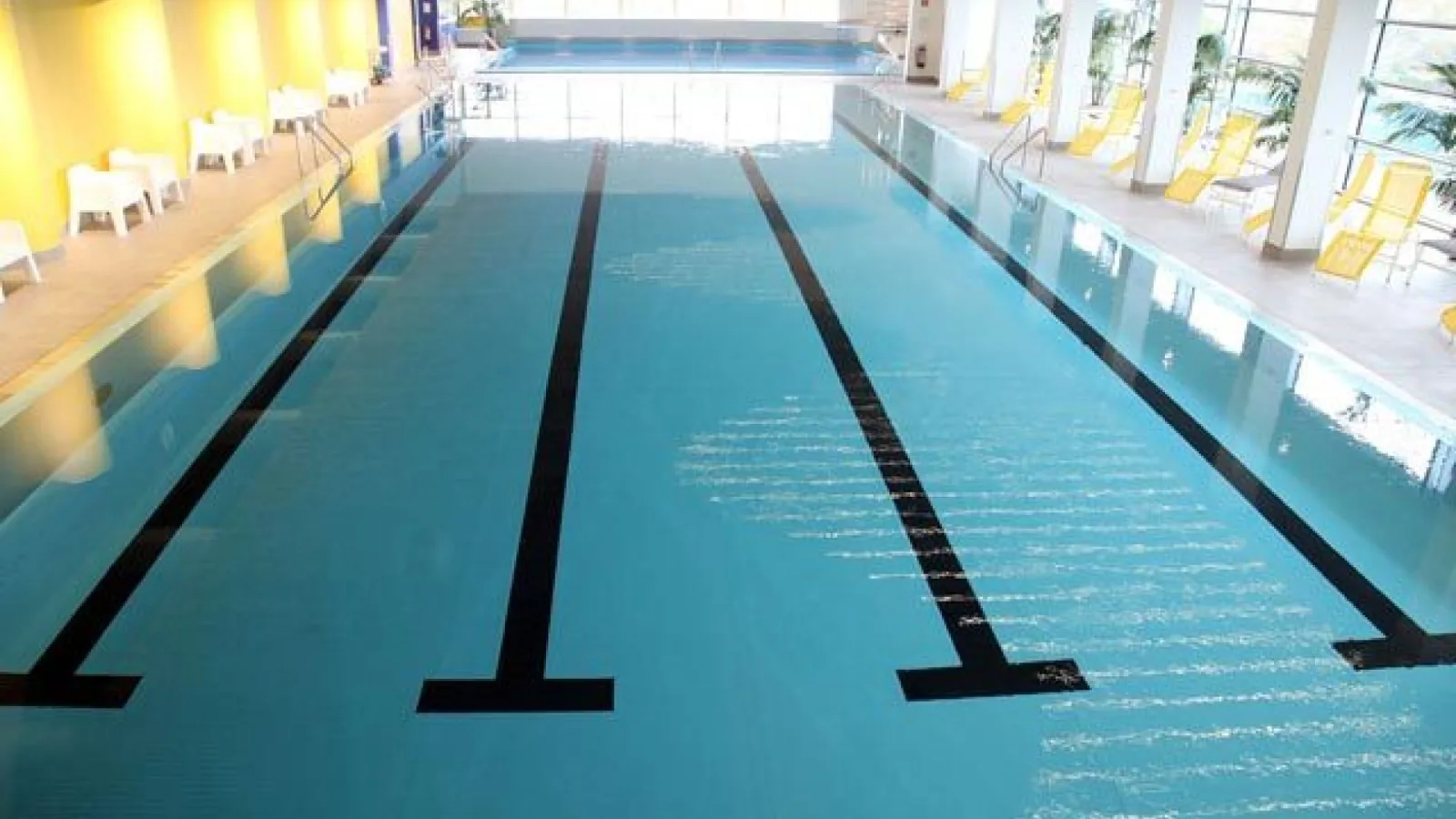
Ottakringer Bad
Vienna · Indoor pool
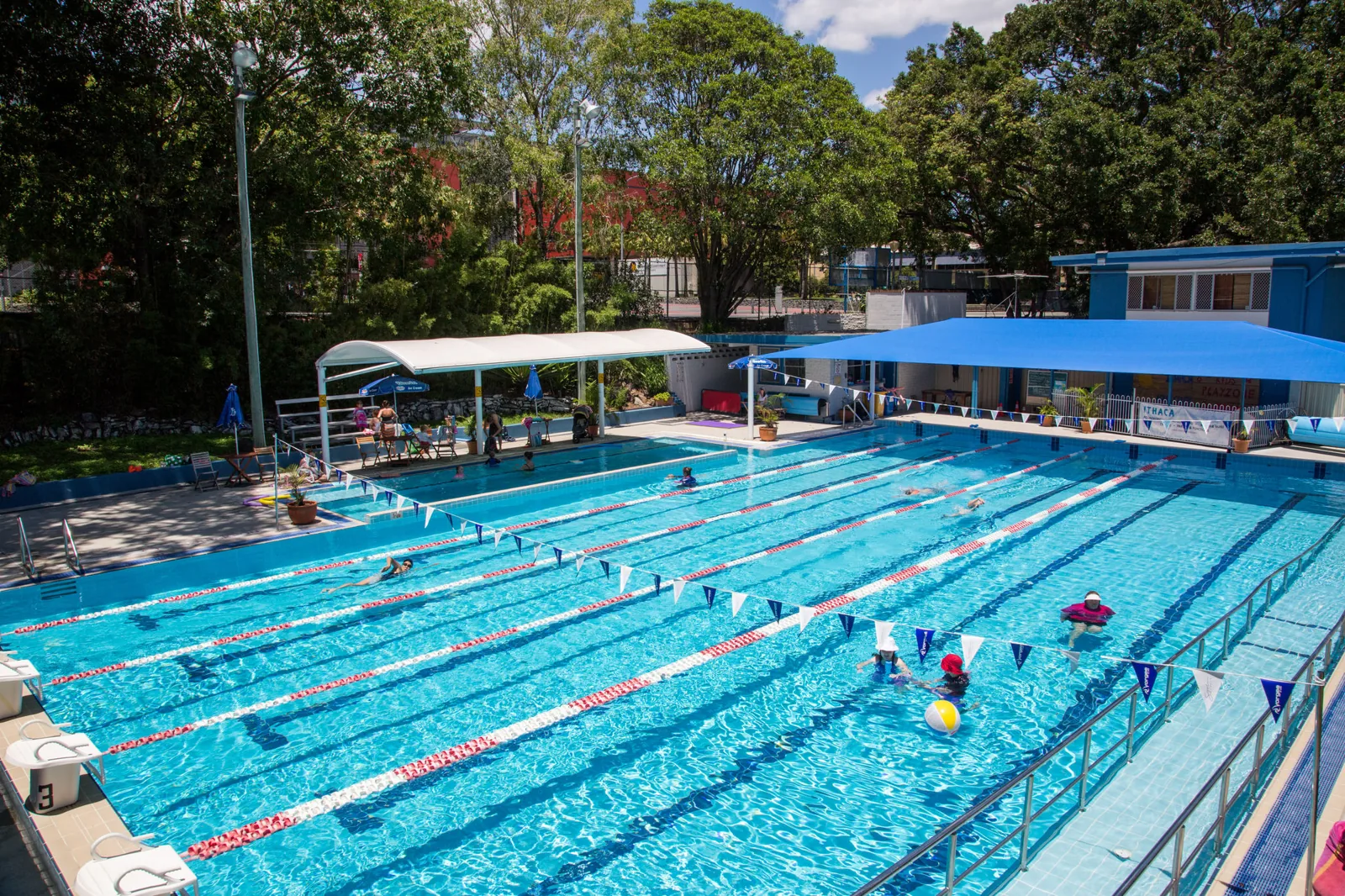
Ithaca Pool
Brisbane · Saltwater 25 m pool
Lentpark
Cologne · Indoor 25 m pool
FAQ
Is there bleach in swimming pools?
In a sense. Many pools dose sodium hypochlorite, the same chemical as household bleach, but at a tiny fraction of the strength. At pool levels it disinfects the water without harming swimmers.
What is the flocculant in pool water?
Public pools usually use a coagulant such as polyaluminium chloride, dosed in small amounts before the filters. It clumps fine particles together so the sand filters can catch them.
Do saltwater pools have no chemicals?
No. A saltwater pool makes its own chlorine from the salt and still needs pH control and the same water balance chemicals as any other pool.
Why do some pools use bromine?
Bromine holds up better in hot water, so it is common in hot tubs and some spa pools. It is less common in main swimming pools because it costs more.