Why do pools smell of chlorine?
 By the Find My Swimming Pool team·
Updated ·
5 min read
Most people think that sharp swimming pool smell means plenty of chlorine and a clean pool. It is close to the opposite. The smell tells you how much chlorine has already reacted with what swimmers left in the water.
The short answer
The "chlorine" smell at a pool mostly comes from chloramines, not chlorine. Chloramines form when chlorine reacts with urine, sweat, skin cells and cosmetics that swimmers bring in. They escape from the water into the air, especially in indoor pools. A strong smell means more of these by-products, usually from busy sessions, unwashed swimmers or poor ventilation. A clean, well-run pool has only a faint smell, according to the CDC.
Where the smell comes from
Chlorine in pool water is there to kill germs. It also reacts with anything containing nitrogen, and swimmers bring in a lot of that: urine, sweat, skin flakes, plus deodorant, make-up and hair products.
The reaction creates chloramines, which pool staff measure as "combined chlorine". There are three kinds: monochloramine, dichloramine and trichloramine. Trichloramine is the one that escapes most easily into the air and gives off the sharp, eye-watering smell most people call "chlorine". It is also the main irritant behind red eyes and coughing at indoor pools.
Pure free chlorine at normal pool levels smells of very little. That is why a well-run pool can have almost no smell even though it is properly chlorinated.
What a strong smell tells you
The CDC says a healthy pool does not have a strong chemical smell. A strong smell usually means one or more of these:
- The pool has been very busy, with more swimmers than the treatment system can keep up with.
- Swimmers have not showered before getting in.
- Urine in the water. Urine is one of the biggest sources of the nitrogen that forms chloramines. See the pee-in-the-pool dye myth.
- Poor ventilation, so gas that leaves the water hangs over the pool.
- Not enough fresh water being added to dilute the build-up.
It does not usually mean the pool has too much chlorine. In fact, chloramines use up chlorine, so a smelly pool can be short of the free chlorine it needs.
The smell on your skin. The smell that follows you home after a swim is chlorine and chloramines bound to your skin and hair. A shower with soap straight after swimming removes most of it. See chlorine and your skin.
Why indoor pools smell more
Outdoor pools rarely smell strongly. The open air carries chloramine gas away and sunlight helps break chloramines down in the water.
Indoor pools trap the gas. The CDC notes that chloramines are heavier than air, so they settle in a layer just above the water, right where swimmers breathe. Splashing and busy sessions push more gas out of the water. In winter, some pools reduce the amount of fresh outside air they draw in to save on heating, which lets the smell build up.
That is why the same pool can smell fine on a quiet morning and much stronger after a crowded evening of lessons and lane sessions.
How pools keep the smell down
- Ventilation. Good air handling sweeps fresh air across the water surface and extracts the air above it outside.
- UV and ozone. Ultraviolet lamps or ozone in the treatment plant break chloramines down before the water returns to the pool. Many modern and refurbished pools use UV for this reason. See UV and ozone pools.
- Superchlorination. Closing the pool and raising chlorine levels for a time to burn off chloramines, then bringing the level back down. The CDC describes raising free chlorine to 10 times the combined chlorine level.
- Dilution. Replacing a share of the pool water with fresh water every day.
- Limits. UK guidance from PWTAG says combined chlorine should be less than half the free chlorine and never above 1 mg/l. The CDC says most US health departments set a limit of 0.4 ppm.
What swimmers can do
- Shower before you swim. The CDC says one minute under the shower removes most of the dirt on your body.
- Use the toilet first, and take children for regular toilet breaks.
- Skip the make-up, fake tan and heavy moisturiser before a swim.
- Wear a cap to keep hair products out of the water.
- Tell the lifeguard if the smell is strong or makes you cough. Staff need to know so they can act.
For more on why chlorine is used at all, see why chlorine is added to swimming pools.
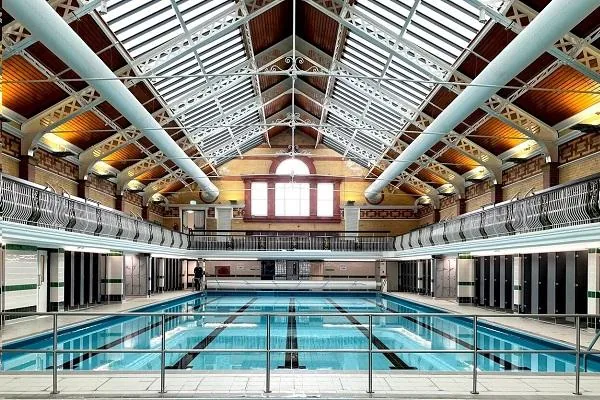
Beverley Road Baths
Hull · Victorian pool
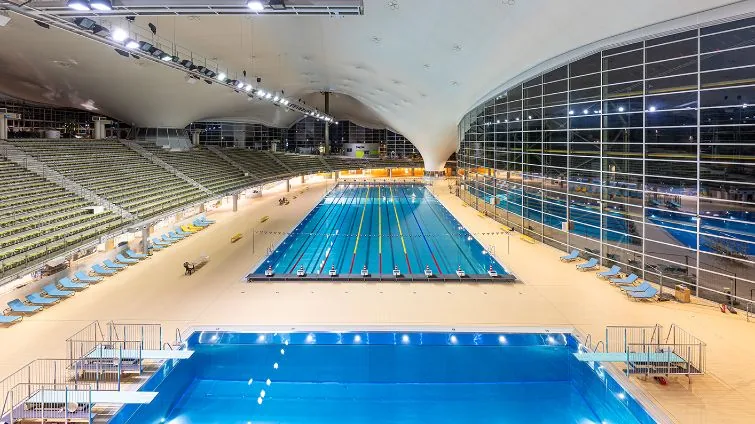
Olympia-Schwimmhalle
Munich · Indoor 50 m pool
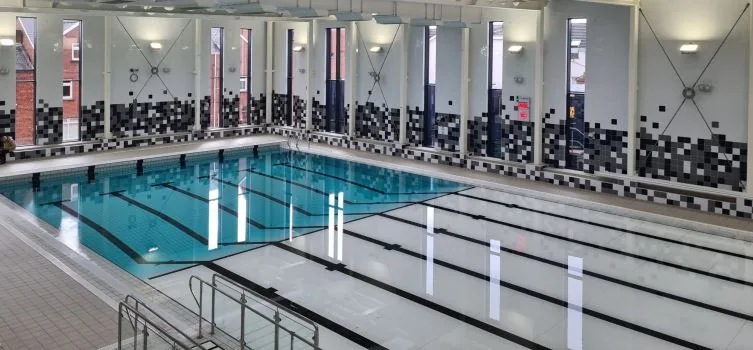
Templemore Baths
Belfast · Six-lane 25 m pool
FAQ
Does a strong chlorine smell mean the pool is clean?
No. A strong smell usually means chloramines have built up from sweat and urine. A clean, well-run pool smells only faintly.
Why do I smell of chlorine after swimming?
Chlorine and chloramines cling to your skin and hair. Showering with soap and washing your hair straight after your swim removes most of the smell.
Is the chlorine smell harmful?
At a well-run pool, no. In a poorly ventilated pool with a strong smell, chloramines can irritate your eyes, nose and throat and can trigger asthma in some people.
Why do outdoor pools smell less?
The open air carries chloramine gas away and sunlight helps break chloramines down, so it cannot build up over the water the way it does indoors.