Olympic swimming pool size
 By the Find My Swimming Pool team·
Updated ·
4 min read
"Olympic-sized" gets used for any big pool, and as a unit of water in news stories. The real thing has exact measurements set by World Aquatics, the governing body for swimming. Here they are, with what they mean when you swim in one.
The short answer
An Olympic swimming pool is 50 m long and 25 m wide, with ten lanes each 2.5 m wide. Only the middle eight are raced in; the two outer lanes stay empty to calm the waves. World Aquatics sets a minimum depth of 2 m and recommends 3 m. At a 2 m depth the pool holds about 2,500 cubic metres, or 2.5 million litres, of water. The water must be kept between 25 °C and 28 °C.
Olympic pool dimensions
| Measure | Metric | Imperial (approx.) |
|---|---|---|
| Length | 50 m | 164 ft |
| Width | 25 m | 82 ft |
| Lanes | 10 (8 used in races) | |
| Lane width | 2.5 m | 8 ft 2 in |
| Depth | 2 m minimum, 3 m recommended | 6 ft 7 in to 9 ft 10 in |
| Water temperature | 25 °C to 28 °C | 77 °F to 82 °F |
| Lighting | At least 1,500 lux over the pool |
The length is exact. It is measured between the touch pads at each end, which is why pools built for top-level racing are slightly longer than 50 m in the concrete. World Aquatics allows the distance between the touch pads to be up to 1 cm over 50 m, but never under, so the bare walls are built 50.02 m to 50.03 m apart (World Aquatics pool certification).
Ten-lane pools are fairly recent. For most of Olympic history the competition pool had eight lanes. Beijing 2008 used ten, and the ten-lane layout has been the standard for major championships since. Lanes 0 and 9, at the walls, act as buffers so waves bouncing off the sides do not hit the swimmers in lanes 1 and 8.
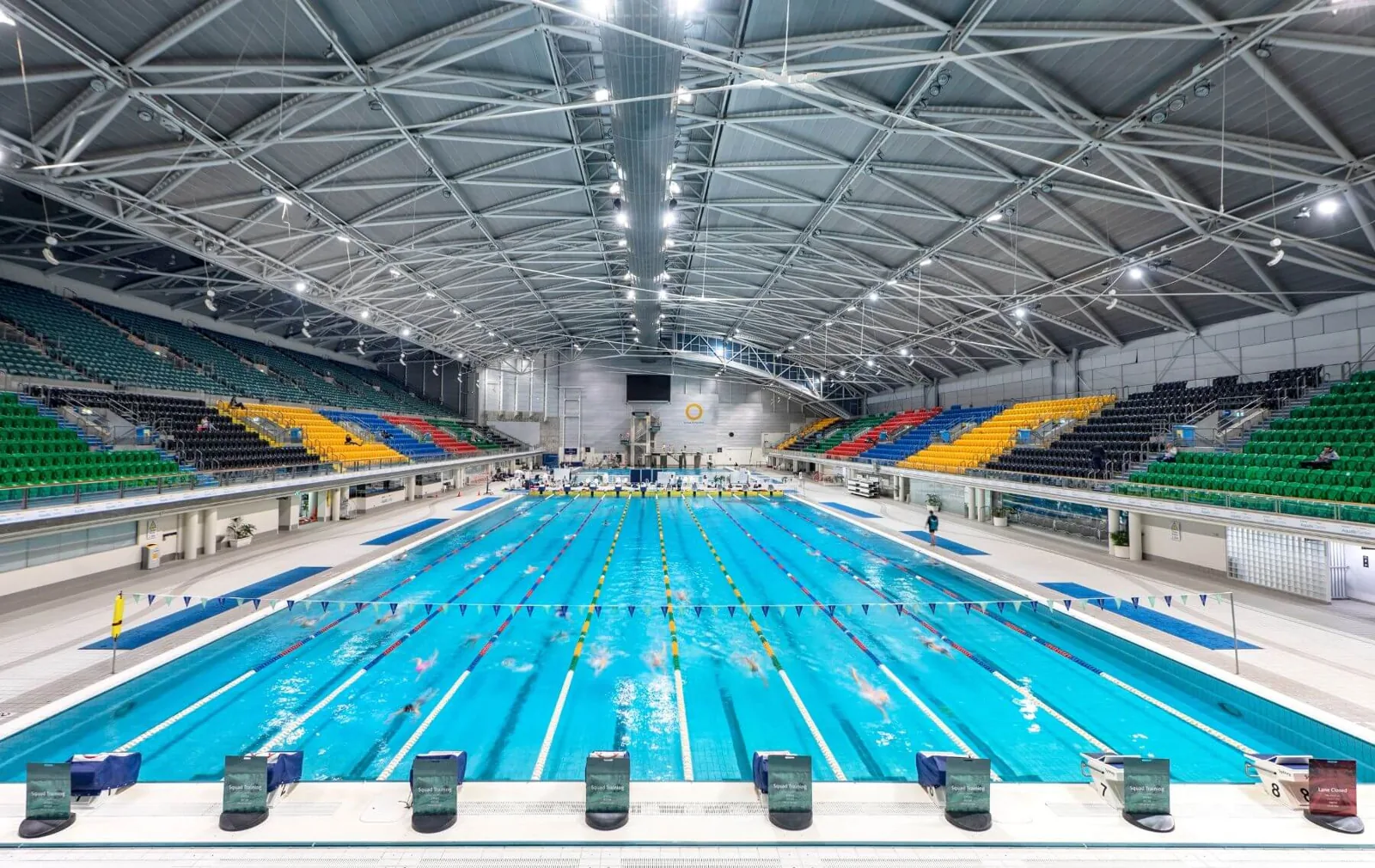
How much water it holds
At the minimum depth of 2 m, the sum is simple: 50 × 25 × 2 = 2,500 cubic metres. That is 2.5 million litres, about 660,000 US gallons or 550,000 imperial gallons.
A pool built to the recommended 3 m holds half as much again, 3,750 cubic metres. That is why news stories that use "Olympic-sized swimming pools" as a unit almost always mean the 2.5 million litre figure.
Why the details matter
- Depth. Deeper water is faster. Waves from swimmers bounce off the floor less, and the water near the surface is calmer. It also makes racing dives from the blocks safer.
- Width. Wide lanes and empty outer lanes mean less turbulence from your neighbours.
- Temperature. 25 °C to 28 °C is cool enough for hard racing. It is a few degrees cooler than most public leisure pools, which feel warm to recreational swimmers.
- Gutters. Modern competition pools have deck-level overflow gutters on all sides, which swallow waves instead of sending them back across the pool.
Olympic-size vs 50 m public pools
Most pools called Olympic-size are 50 m long but not full World Aquatics spec. Typical differences:
- Fewer lanes. Many 50 m public pools have eight lanes and are about 20 m to 21 m wide. Piscine Georges Hermant in Paris, for example, is 50 m by 20 m with eight lanes.
- Shallow ends. Older and community 50 m pools often slope from around 1 m to 2 m or more, rather than being 2 m throughout.
- Moveable floors and booms. Some pools can raise part of the floor, or drop a bulkhead across the middle to make two 25 m pools.
For a lane swimmer none of this matters much. What matters is the 50 m length: fewer turns and longer stretches of uninterrupted swimming. Our 25 m vs 50 m guide explains the difference in practice.
Swimming in one
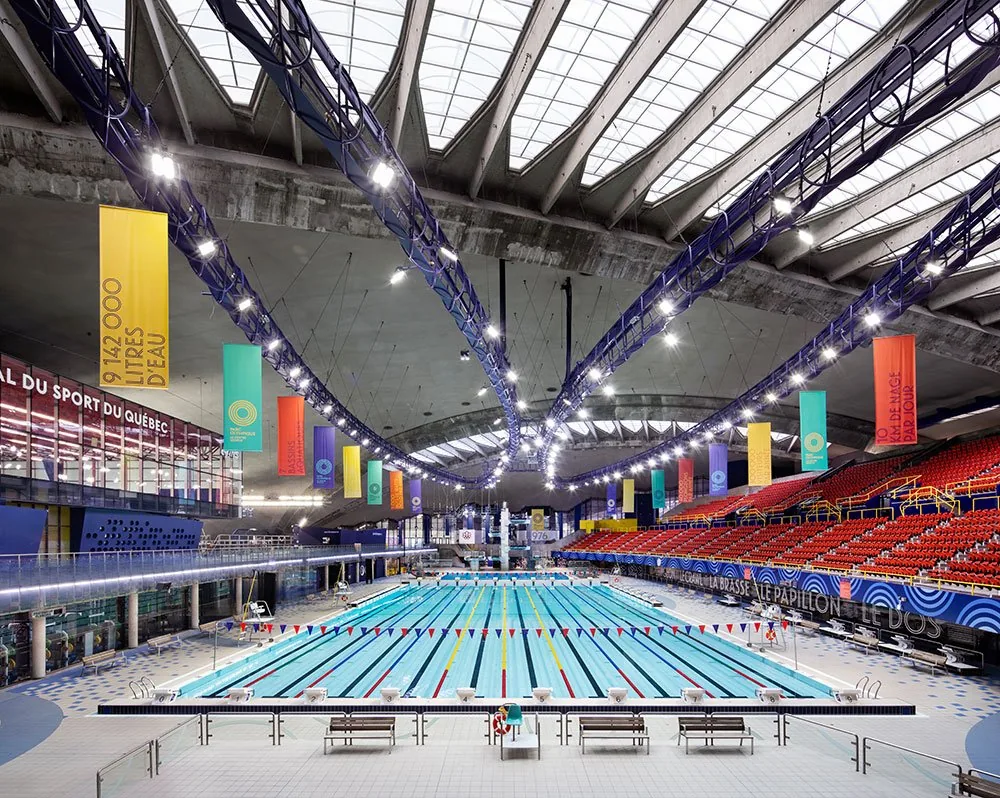
Many Olympic pools from past Games are now public pools you can swim in for the price of a normal session. London's 2012 venue, Munich's 1972 hall, Montreal's 1976 complex and Sydney's 2000 centre all run public lane swimming. Pools built for other big events work the same way: the 10-lane 50 m pool at the Markham Pan Am Centre in Ontario, built for the 2015 Pan Am Games, has drop-in lane sessions. Expect the deep water and the long length to feel harder at first. You cannot stand up halfway, and there are half as many walls to rest on.
Distances are easy to count. 1,500 m is 30 lengths. A mile, 1,609 m, is just over 32 lengths. Our lengths in a mile guide has the full table.
Cities with the most 50 m pools in our directory:
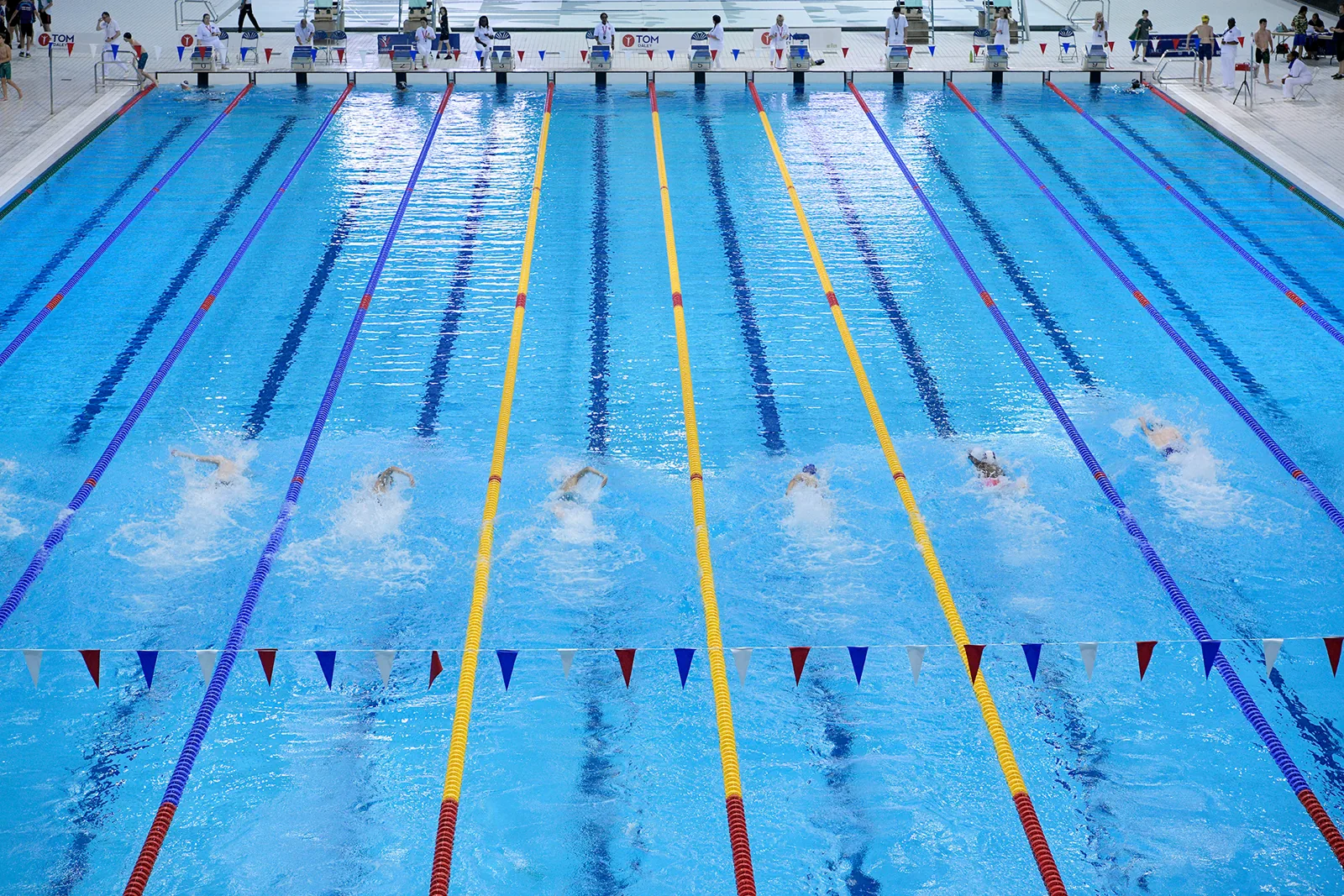
London Aquatics Centre
London · Two 50m pools
Markham Pan Am Centre
Markham · 10-lane 50m pool
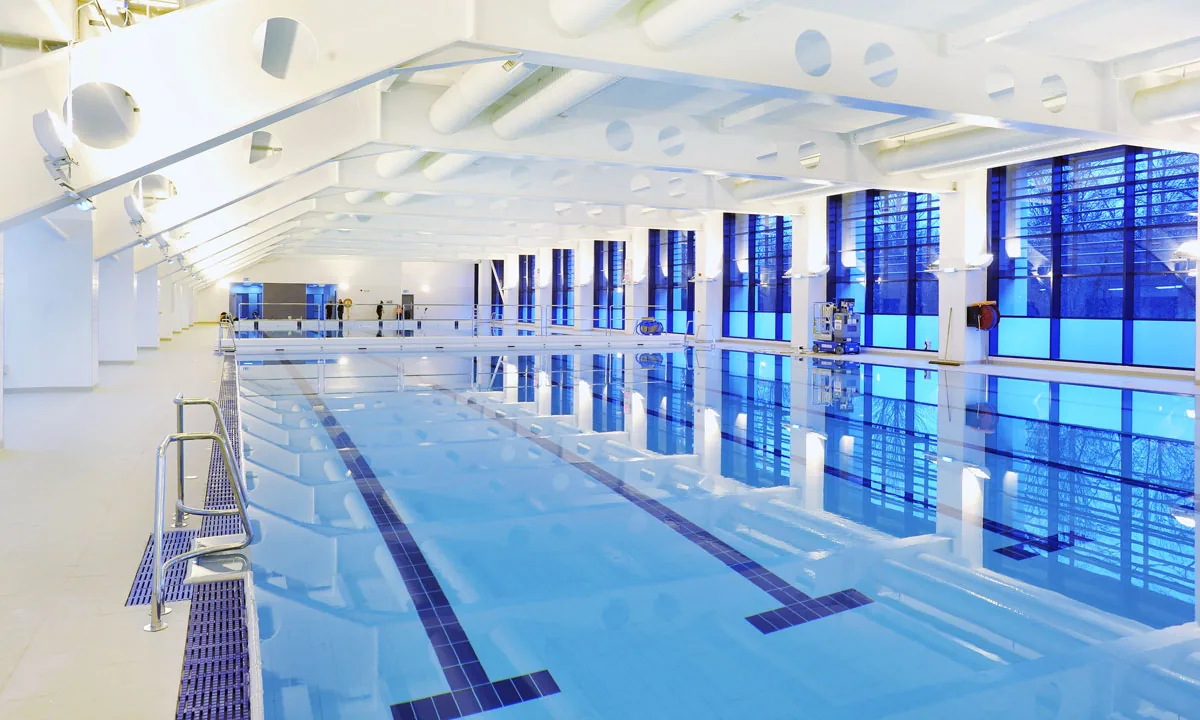
Tollcross International Swimming Centre
Glasgow · 50m and 25m pools
FAQ
How many lengths of an Olympic pool is a kilometre?
Twenty lengths. Each length is 50 m, so 1,000 m is 20 lengths, or ten there-and-back laps.
How deep is an Olympic swimming pool?
At least 2 m, with 3 m recommended by World Aquatics. Not every Games pool reaches 3 m, and many public 50 m pools have a shallower end.
Is a 25 m pool half an Olympic pool?
In length, yes. A 25 m pool is the short course size. Most are also narrower and shallower than an Olympic pool.
How long does it take to fill an Olympic pool?
It depends on the water supply, but at normal mains pressure it takes days, not hours. Pools are rarely emptied; the water is filtered and topped up instead.