What muscles does swimming work?
 By the Find My Swimming Pool team·
Updated ·
5 min read
Swimming is often called a full-body workout, and that is mostly true. But each stroke leans on different muscles, and the big movers are your back and shoulders rather than your legs. Here is what works in each stroke, and what swimming leaves out.
The short answer
Swimming works most of your major muscles. The biggest load falls on your lats (the wide muscles down the sides of your back), shoulders, chest and triceps, which pull and push you through the water. Your core holds your body straight, and your glutes, hips, thighs and calves drive the kick. Front crawl and butterfly are upper-body heavy; breaststroke gets the most from your legs, inner thighs and glutes. Swimming builds endurance more than size, and it does little for bone strength.
The main muscles swimming uses
| Muscle group | What it does in the water |
|---|---|
| Latissimus dorsi (lats) | The main pulling muscle in every stroke. Draws your arm down and back under your body. |
| Shoulders (deltoids and rotator cuff) | Lift the arm out of the water, reach forward and keep the shoulder joint stable. |
| Chest (pectorals) | Sweeps the arm inwards in breaststroke and butterfly, and helps the pull in front crawl. |
| Triceps | Straighten the elbow to finish the push at the end of each stroke. |
| Biceps and forearms | Hold the bent-elbow "catch" and keep your hand angled against the water. |
| Core (abdominals, obliques, lower back) | Keep you long and level and transfer power from hips to arms. |
| Glutes and hip flexors | Start the kick from the hip. |
| Quadriceps and hamstrings | Straighten and bend the knee through the kick. |
| Calves and ankles | Point the feet and add a little whip at the end of the kick. |
Muscles by stroke
Front crawl (freestyle)
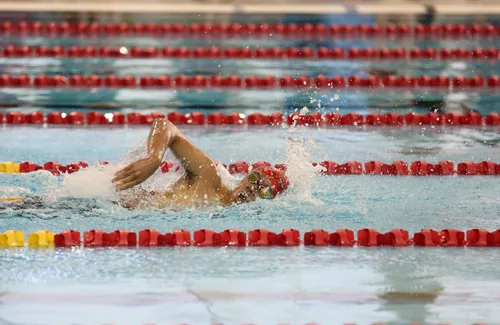
The arms provide most of the speed. Your lats and shoulders do the heavy pulling, triceps finish each stroke, and your core rotates your body from side to side so the big back muscles can join in. The flutter kick uses hip flexors, glutes, quads and a little calf, mainly to keep your legs up and balance the arms. Swimmers who kick from the knee rather than the hip tire their thighs quickly.
Breaststroke
This is the most leg-heavy stroke. The whip kick drives you forward with your glutes, quads, hamstrings and the inner thigh muscles (adductors) that snap your legs together. The arm pull uses chest and lats in a short sweep. Breaststroke also uses your lower back as you lift to breathe. If you have knee or hip pain, the whip kick can aggravate it; swapping to a gentle flutter kick with breaststroke arms is a common fix.
Backstroke
Your lats and the back of your shoulders pull, with your arms rotating behind you. The kick is the same flutter kick as front crawl, but on your back it works your hip flexors and quads a little more. Your core keeps your hips near the surface. Backstroke opens the chest and is a useful balance to the hunched shape of front crawl and breaststroke.
Butterfly
The hardest stroke. Both arms pull together, so your lats, chest, shoulders and triceps work at full stretch. The dolphin kick is a wave that starts in your chest and runs through your abs, lower back and glutes to your feet. It is a strong core workout, and why butterfly burns the most calories (see calories burned swimming).
Health Hydro
Swindon · Victorian pool
Spring Hill Baths
Brisbane · Heritage indoor pool
QM Sports Centre
Basingstoke · Pool lanes
Why your core works so hard
In the water you have nothing to push against. Your core has to hold your body in a straight line so your legs do not sink and your hips do not swing from side to side. Every time your arm pulls, your trunk has to stay firm enough to pass that force along your body. That is why new swimmers often feel their stomach and lower back after a session, even without doing a single sit-up.
Use equipment to focus on one area. A pull buoy between your thighs stops your kick, so your arms and back do all the work. A kickboard does the reverse. Most public pools have both at the poolside, free to use.
What swimming misses
- Bones. Because the water takes your weight, swimming does little to load your skeleton. Bones get stronger with impact and weight-bearing exercise.
- Heavy leg strength. The kick builds endurance, but not the strength you would get from squats, climbing stairs or cycling uphill.
- Pushing muscles in balance. Swimming is mostly pulling. Lots of swimmers develop strong lats and tight chests. Simple press-ups and band exercises for the upper back help keep shoulders healthy.
Two short strength sessions a week on land cover most of this.
Will swimming build muscle?
Some, especially when you start. New swimmers often notice firmer shoulders, back and arms within a couple of months. But water resistance is light, and you repeat each stroke hundreds of times, so swimming mostly builds endurance rather than size. Competitive swimmers have broad backs and shoulders because they swim many kilometres a week and also lift weights.
If you want more muscle, add resistance in the pool with paddles or drag shorts, or combine swimming with strength training. Our guide to swimming benefits covers the wider health effects, and swimming vs running compares the two for fitness.
FAQ
Which swimming stroke is best for abs?
Butterfly works the abs hardest because the dolphin kick starts from the core. Front crawl and backstroke also train the obliques through body rotation.
Does swimming work your legs?
Yes, but less than your upper body in most strokes. Breaststroke uses the legs most. Kickboard sets are a good way to add leg work.
Why do my shoulders ache after swimming?
Your shoulders do a lot of the work, and new swimmers often over-reach or cross the arm in front of the head. Build up gradually, mix in backstroke, and get a technique check if the ache lasts.
Is swimming enough for strength training?
Not on its own. It builds muscular endurance, but the NHS guidelines also call for muscle-strengthening activity on two days a week. Short sessions of press-ups, squats or weights fill the gap.